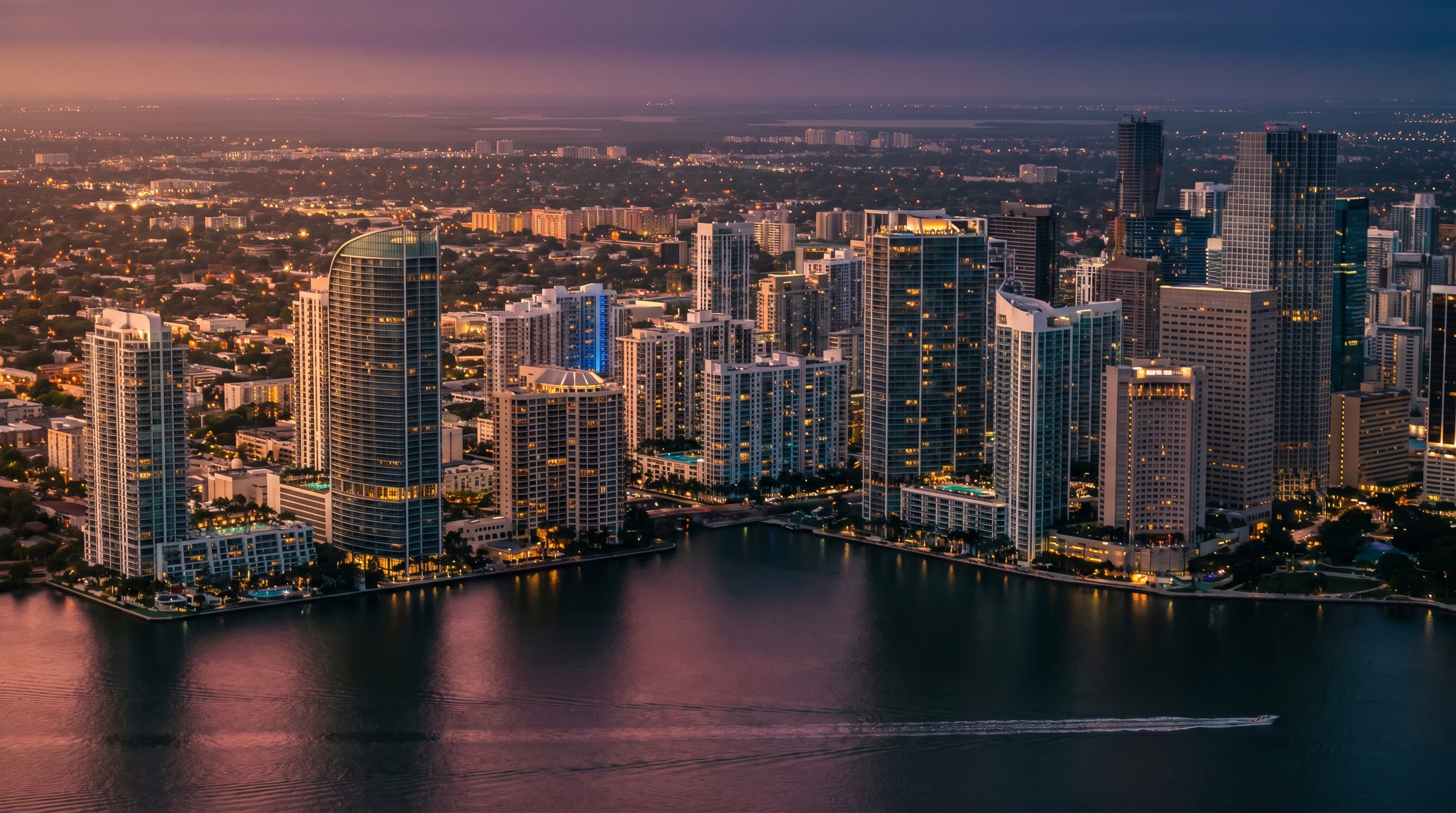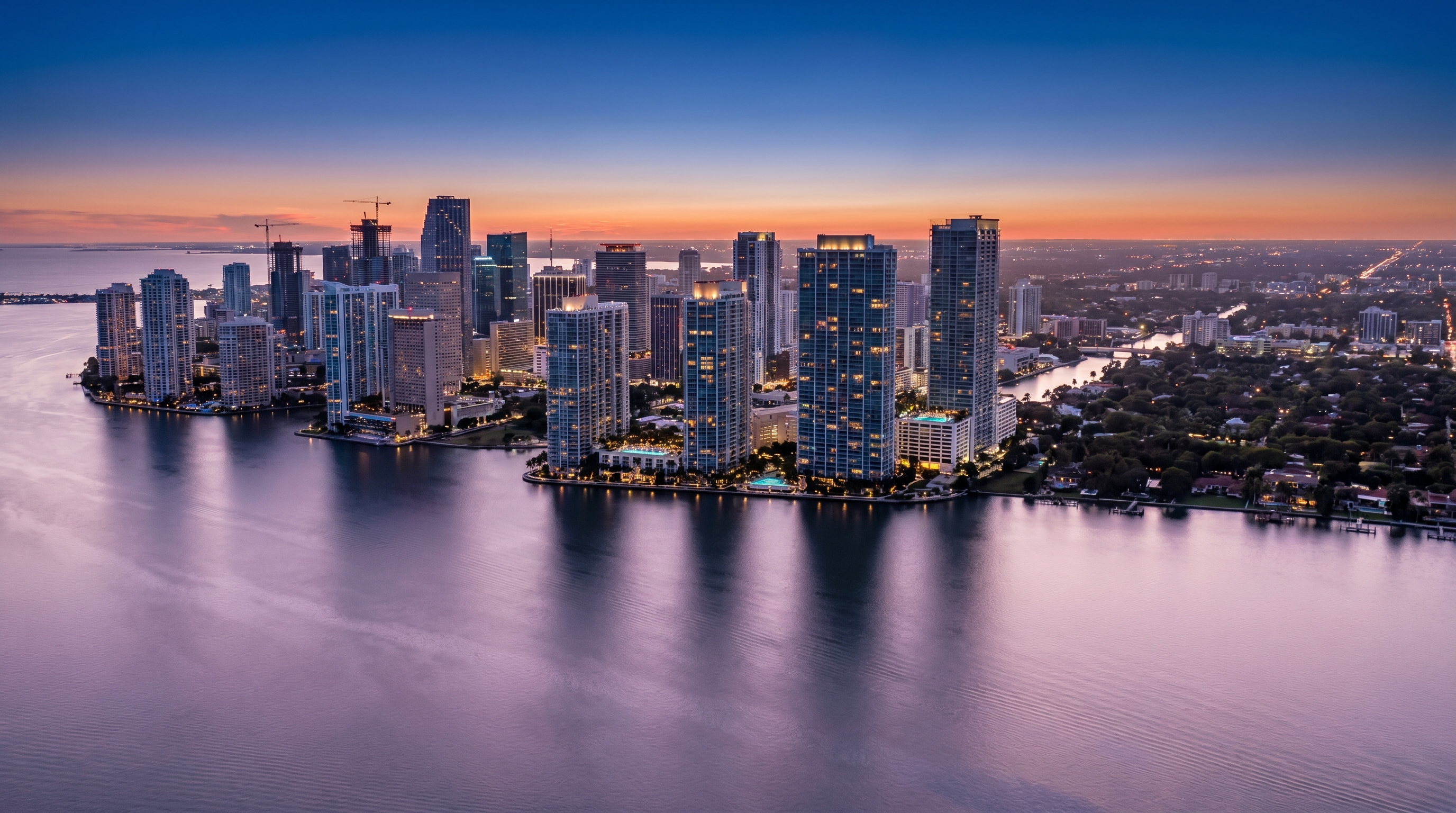

Miami's real estate market in late May 2026 is doing something I haven't seen in fifteen years of working this city. Two markets — commercial office and residential condo — are moving in opposite directions at the same time, with the same intensity. Office is at record highs. Condos are at multi-year inventory peaks. Both are happening within the same five-mile radius of Brickell Avenue.
If you're a buyer, a seller, or an investor in Miami right now, this split is the single most important thing you need to understand. Most agents are still talking about "the market" as if it's one thing. It isn't. Here's what's actually happening, broken cleanly into the two markets — and what to do about it.
The commercial story: the most expensive office space in Miami history
Let's start with the data that broke this week. Miami-Dade office asking rents officially crossed $200 per square foot in premium submarkets, with letters of intent confirming the threshold across multiple Class A buildings. Signed leases are now regularly clearing $150 per square foot full-service gross, according to industry reporting on May 18 and 19, 2026. Both numbers are records.
This isn't speculation. This is closed paper. And the buildings doing the clearing aren't just Brickell trophy towers — they're newer Coral Gables Class A space, top-of-market Coconut Grove waterfront product, and a handful of well-located Wynwood and Edgewater conversions.
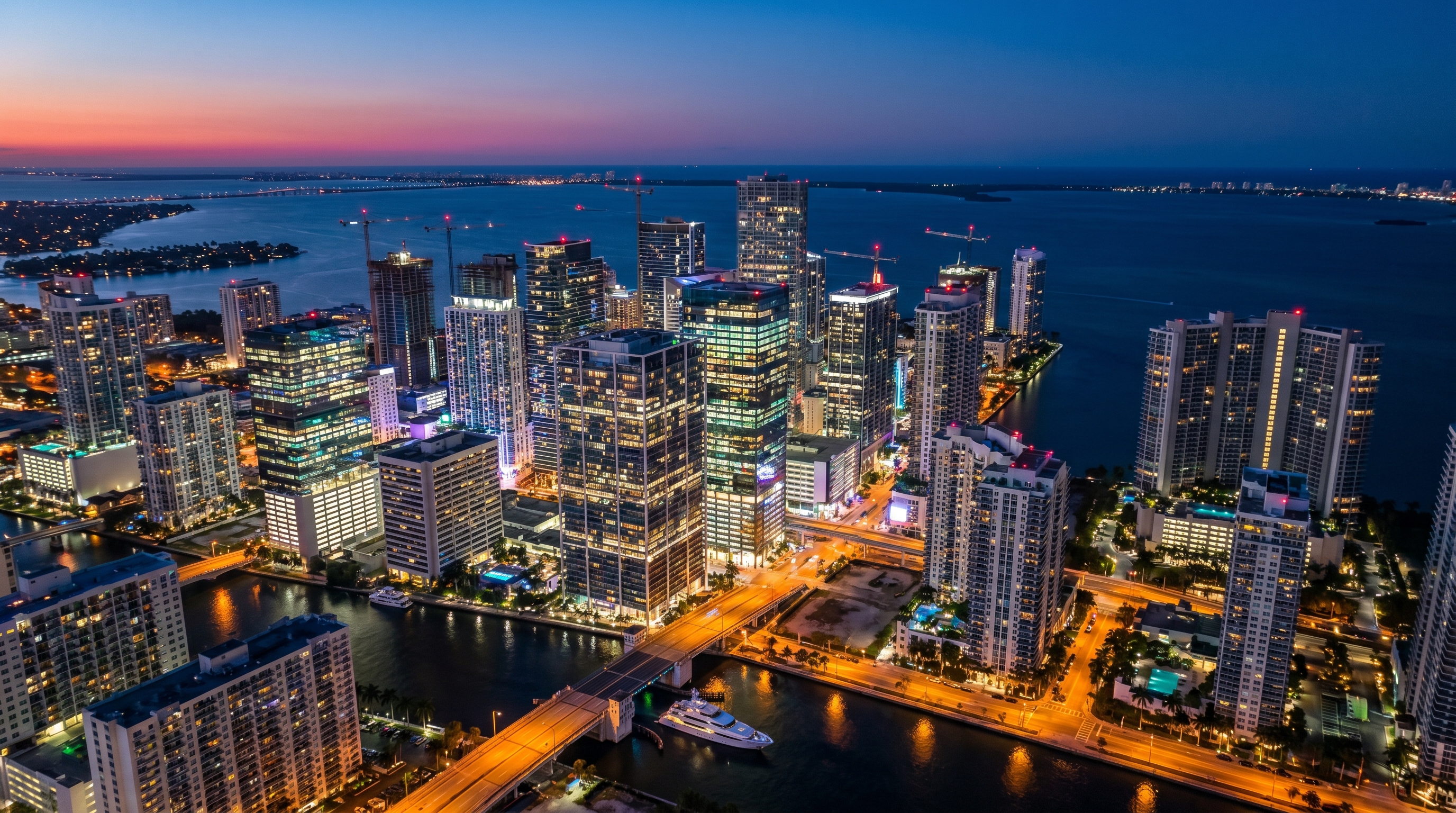
Three forces are driving it. First, finance and law firms continue to relocate Northeastern operations to Miami, and they're not coming for B-grade space. Second, the supply pipeline of new Class A office is genuinely thin — most of the development cranes you see across the skyline are pointed at residential condos, not offices. Third, the firms that arrived in 2022–2024 are now expanding, and they're competing for the same finite premium inventory.
For Miami business owners, this is the single clearest buy-versus-rent signal I've seen since 2015. I covered the math in detail in my article "Miami Office Rents Just Crossed $200/SqFt: Why Smart Business Owners Are Buying Instead of Renewing in 2026," and the short version is that owning a 5,000–8,000 SqFt commercial condo now beats renewing premium Class A space on almost every measure that matters.
The residential condo story: a buyer's market with real leverage
Now flip to the opposite side of the same city. The Miami-Dade condo market sits on approximately 13 months of supply — meaning if no new listings hit the market starting today, it would take just over a year to absorb everything currently for sale. A balanced market is six months. A seller's market is under four. We are nowhere close.
Average days on market in many condo segments is now in the 75–100 day range — more than double the levels of just two years ago. Price reductions have become routine; well-priced product still moves, but anything listed aspirationally sits and stales. The two-tier split I wrote about in my "Miami Condo Market Mid-May 2026" piece has only widened.
Why? Three reasons that mostly mirror the commercial story in reverse. First, the post-Champlain Towers condo reserve law has pushed thousands of older condo units onto the market as owners decide they don't want to pay six-figure special assessments. Second, the pre-construction pipeline of new condos is enormous — buyers are looking at glittering 2027 and 2028 deliveries and feeling no urgency about resale inventory. Third, interest rates remain elevated enough that financed buyers are doing real math on monthly payments, which favors negotiation rather than full-ask offers.
For condo buyers in 2026, this is genuinely the best leverage we've seen since 2010. I covered the negotiation playbook in "How to Negotiate a Miami Home in a Buyer's Market," and the tactics in that article are working right now.
The two-tier split inside the condo market
It's important to understand that "13 months of supply" is the average. The reality is far more split.
New construction and recently delivered luxury condos in Brickell, Edgewater, and Miami Beach are moving — slower than during the 2022 frenzy, but moving. Branded residences (Baccarat, Cipriani, Mandarin Oriental, Waldorf Astoria) continue to clear high price-per-SqFt benchmarks. International capital, particularly from Latin America, still favors trophy product.
Where the inventory really sits is in mid-tier resale condos built between 1980 and 2010, particularly in buildings that have not completed their reserve studies or have flagged structural assessments. These units are sitting six, nine, twelve months on market. Sellers who priced ahead of the curve in 2024 are now cutting 5–12%. Sellers who priced realistically in spring 2026 are clearing — but only because they accepted that the buyer set their price.
If you're buying in this segment, your leverage is real. If you're selling in it, your pricing strategy is the entire game.
Miami Market Snapshot — May 2026:
- Miami-Dade office asking rents: $200+/SqFt in premium submarkets (record high)
- Signed office deals: regularly exceeding $150/SqFt full-service gross
- Miami-Dade condo inventory: approximately 13 months of supply (multi-year high)
- Average days on market for resale condos: 75–100 days, depending on segment
- Median Miami-Dade single-family home price: approximately $650K (essentially flat YoY)
What this means for the four types of Miami buyers and sellers
If you're a business owner: Buy your office building. The math has flipped decisively. Lock in an SBA 504 pre-qualification this month and start looking at commercial condos in your target submarket. The longer you wait, the worse the buy-versus-rent comparison gets.
If you're a residential buyer: This is your moment. Bring real comps, ask for concessions you wouldn't have dreamed of in 2022, and negotiate on price, closing credits, rate buy-downs, and post-closing repairs simultaneously. Don't fall in love with a listing — fall in love with the underlying math.
If you're a residential seller: Pricing is everything. The market will absorb correctly-priced inventory in 45–60 days; it will punish aspirational pricing for six months or more. Get your pre-listing checklist tight, get the financial reserves narrative ready for buyers, and price to the comp set as it exists today, not as it was twelve months ago. I broke down the full strategy in "Selling a Miami Property in 2026: The Pricing Strategy That Actually Closes Right Now."
If you're an investor: Look hard at owner-occupied commercial product (the math is best here), at pre-construction condos in the genuinely supply-constrained submarkets (Brickell waterfront, Coconut Grove, Coral Gables), and at value-add resale condos in well-managed buildings with completed reserve studies. Avoid mid-tier 1980s–2000s condos in flagged buildings unless you understand exactly what you're inheriting.
The seasonal wrinkle: summer 2026 is going to be slow
One more piece of context. Miami real estate has clear seasonality — the spring high season ends in late May, and summer is historically slower across both transaction volume and price action. That means the condo inventory pile probably gets worse before it gets better, and the price-cutting trend I covered in "Why Miami Sellers Are Quietly Cutting Prices in Summer 2026" is likely to accelerate through July and August.
For buyers, that means even more leverage is coming. For sellers, it means now is the moment to either commit to a realistic price or pull the listing and wait for fall.
Frequently Asked Questions
Q: Is now a good time to buy a home in Miami?
A: For residential condos and single-family homes, yes — this is the strongest buyer's market Miami has seen since 2010. Active inventory is at a 13-month supply, days on market are extended, and motivated sellers are negotiating on price, closing costs, and concessions in ways that didn't exist eighteen months ago.
Q: Why are Miami condo prices going down while office rents are going up?
A: Different supply and demand dynamics. Office space has tight new supply and rising corporate demand from relocating firms. Condos have massive new supply coming from a pre-construction pipeline and older buildings under reserve-law pressure, against a more cautious buyer pool.
Q: What is the best Miami neighborhood to buy in 2026?
A: It depends on your goal. For business owners buying commercial, Brickell and Coral Gables. For residential value with future upside, Edgewater and Coconut Grove. For pure international trophy product, Brickell waterfront and Sunny Isles. The right answer matches your specific use case.
Q: How long do Miami homes sit on the market in 2026?
A: Condos average 75–100 days depending on segment and price tier; single-family homes typically move faster, in the 45–70 day range. Anything priced realistically and presented well can still move in under 45 days. Aspirational pricing now means six-plus months on market.
Let's find your next property together.
Carlos Cabale / Partnership Realty Inc / +1 (561) 629-0358 / carloscabalerealtor.com