

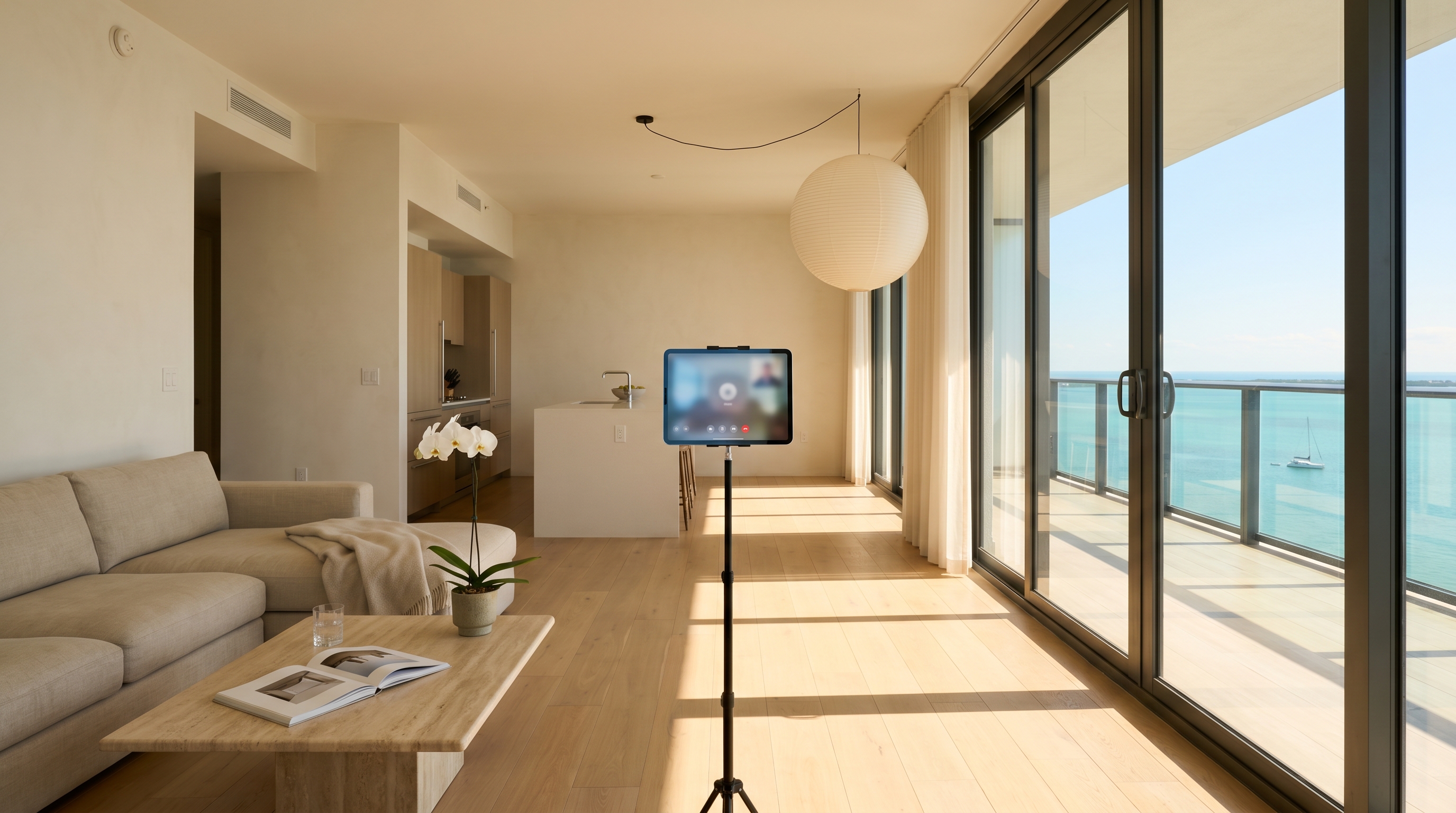
A growing share of my buyer clients in 2026 has never set foot on the property they're buying. New Yorkers fleeing winter, Californians selling for cash, Latin American families consolidating into Miami, Texan business owners opening a second home — they're all closing from a thousand miles away, sometimes from another country, and they're doing it confidently/.
But not all of them do it well. The Miami buyer's market we're in right now — 13 months of condo inventory, motivated sellers, real negotiation leverage — also means more inventory has hidden problems, and more sellers are willing to obscure them. Sight-unseen buying without the right system is how out-of-state buyers end up owning the wrong condo in the wrong building at the wrong price.
Here's the eleven-step playbook I use with every remote client. It's not optional. It's the entire reason they close on homes they actually want to live in.
Step 1: Know your true budget before you make a single offer
This sounds obvious, but in Miami it isn't. Your monthly cost of ownership in a condo isn't just principal, interest, taxes, and insurance — it's also the HOA fee, special assessments, hurricane insurance riders, flood insurance (often required), and the reserve-study assessment ramping up post-2025. A unit that looks like a $4,200/month payment on Zillow can be a $7,400/month payment in reality.
Build your actual monthly cost spreadsheet before you start touring listings remotely. Your Miami realtor should help you stress-test it for the building's specific assessment profile, not the average.
Step 2: Pick the right neighborhood before you pick a property
This is the most common sight-unseen mistake I see. Out-of-state buyers fall in love with a unit on Zillow without understanding that the neighborhood three blocks west has 30% lower crime, the neighborhood two blocks east floods routinely, and the building they're targeting is sandwiched between a nightclub and a construction site.
My relocation guides for buyers coming from New York, California, and Latin America go deep on this, and the rule is the same: choose your zone first based on lifestyle (Brickell for downtown professionals, Coral Gables for families, Coconut Grove for trees and boats, Aventura for international buyers, Doral for business owners). Then look at units inside that zone — not the other way around.
Step 3: Insist on a live, unedited video tour by your agent
Not a pre-recorded marketing video. A live FaceTime, Zoom, or WhatsApp video call where your agent walks you through every room, every closet, every outlet, every window view, every smell, every noise. They open every cabinet. They run the water. They flush the toilets. They check the windows for hurricane impact glass markings.
If your agent won't do this, you have the wrong agent. This is the absolute baseline for a sight-unseen purchase in 2026.
Step 4: Demand a second-tier inspection that includes the building, not just the unit
For condos, this is the step that catches the worst problems. A standard unit inspection looks at appliances, HVAC, plumbing, electrical, and finishes. It does not look at the building's structural reports, the reserve study, the special assessment history, or the litigation log.
I require a building-level review on every sight-unseen condo offer my clients make. We pull the most recent SIRS (Structural Integrity Reserve Study) report, the latest reserve study, the last three years of board minutes, current and historical special assessments, the insurance master policy, and any open litigation. I broke down the full red-flag framework in "How to Read a Miami Condo Building's Financials Before You Buy" — read it before you sign anything in Miami.
Step 5: Run the Florida condo reserve law check
Florida's post-Champlain Towers condo reserve law has reshaped Miami's condo market more than any other single regulation. Buildings over three stories built before specific cutoffs must complete milestone structural inspections and reserve studies, and the assessments coming out of those reports range from manageable to financially devastating.
If you're buying in any building over thirty years old, your agent needs to tell you exactly what milestone inspection has been completed, what was found, what the resulting assessment is, and whether it's been paid or financed. No assumptions, no estimates, no "we'll figure it out post-closing." I covered the full framework in "Florida's Condo Reserve Law: What Every Miami Condo Buyer Must Check Before Closing in 2026."
Step 6: Get a third-party inspection from someone you found, not the seller
The seller's preferred inspector is not your friend. Find an independent licensed Miami home inspector — your buyer's agent will have a roster of three or four they trust — and pay for the inspection yourself. Demand the full digital report with photos of every system. Get a moisture reading on every exterior-facing wall. Have them check the hurricane shutter mechanisms, even if it's June. Have them look at the roof, even on a condo.
Step 7: Build in a sight-unseen escape hatch
Every sight-unseen offer my clients make has a specific contingency that other buyers don't think to include: a personal in-person inspection contingency, typically 5–10 days, that runs concurrently with the standard inspection period. This gives you the right to fly down, walk through, and walk away with your deposit intact if anything material fails the in-person test.
Sellers in this market accept this contingency. They aren't in a position to refuse reasonable terms. If your agent isn't building this in, ask why.
Step 8: Have your title company licensed in Florida and your closing attorney in Miami
Florida is an attorney closing state in practice for most luxury transactions, even though title companies can handle simpler closings. For a sight-unseen out-of-state buyer, the closing attorney is your local eyes and ears for everything that happens between contract and key handoff. Get one in Miami who you've actually spoken to on the phone before contract.
Step 9: Wire fraud is the single biggest financial risk you face
I cannot say this loudly enough. Wire fraud targeted at out-of-state real estate buyers is a multi-billion-dollar problem nationally and is rampant in Florida. Scammers compromise email accounts at title companies or law firms, send fake wiring instructions days before closing, and the money is gone the moment it lands.
The rule: never wire funds based on emailed instructions. Always call the title company or closing attorney at a phone number you independently verified (from their official website, not from the email) and confirm wiring instructions verbally. Do this every single time, including on the day of closing.
Step 10: Verify before you waive any contingencies
Out-of-state buyers under pressure to close often waive contingencies they shouldn't. The financing contingency, the inspection contingency, the appraisal contingency, and the personal inspection contingency exist to protect you. Waive nothing without explicit written advice from your agent and attorney that the math actually works.
Step 11: Don't close until your in-person walkthrough happens
The final walkthrough — the one that happens 24 to 48 hours before closing — needs to happen in person, not on FaceTime. Either fly down yourself, send a trusted friend, or have your agent execute a detailed checklist on a recorded video call where they verify every condition, every included item, every system, and every defect identified during the inspection. The walkthrough is the last gate before millions of dollars move. Treat it that way.
Miami Market Snapshot — May 2026:
- Estimated share of Miami buyers closing sight-unseen: 22–28% (up from ~12% pre-2022)
- Median Miami-Dade single-family home price: approximately $650K, essentially flat YoY
- Active condo inventory: approximately 13 months of supply across Miami-Dade
- Average days on market for resale condos: 75–100 days
The bottom line for out-of-state buyers
The Miami buyer's market in 2026 is genuinely the best leverage moment for relocators in over a decade. But leverage only works if you don't make sight-unseen mistakes that erase it. The system above isn't paranoia — it's the difference between buying confidently from a thousand miles away and buying a problem you'll spend three years trying to unwind.
If you're moving from New York, California, or anywhere else, my earlier guides — "Relocating to Miami from New York: The 2026 Honest Guide," "Relocating to Miami from California in 2026: The Honest Cost-of-Living and Real Estate Guide," and "Relocating to Miami from Latin America in 2026" — go deeper on the lifestyle and tax math. This article is the operational playbook to actually close the deal.
Frequently Asked Questions
Q: Can I buy a home in Miami without visiting in person?
A: Yes — roughly a quarter of Miami buyers in 2026 close without physically touring first. With a live agent video walkthrough, an independent inspection, a reserve-study and financial document review, and a built-in personal inspection contingency, sight-unseen buying is safe and increasingly common.
Q: What's the biggest mistake out-of-state buyers make in Miami?
A: Ignoring the building, not the unit. The unit can look perfect while the condo association is sitting on a six-figure special assessment, failed structural inspection, or open litigation. Sight-unseen buyers who only inspect the apartment, not the building, get destroyed by post-closing assessments.
Q: How do I find the best Miami realtor for a sight-unseen purchase?
A: Ask three questions: How many sight-unseen closings have you done in the last twelve months? Will you do a live video walkthrough of every property I'm seriously considering? Can you walk me through the building's reserve study before I make an offer? If the answer to any is vague, keep looking.
Q: How long does it take to buy a home in Miami from out of state?
A: From first offer to closing, typically 35–60 days for financed buyers and 21–35 days for cash buyers. Add 7–14 days upfront for property selection if you haven't already narrowed your search. International buyers should add 14–21 days for funds transfer and documentation.
Whether you're buying, selling, or investing — I've got you.
Carlos Cabale / Partnership Realty Inc / +1 (561) 629-0358 / carloscabalerealtor.com