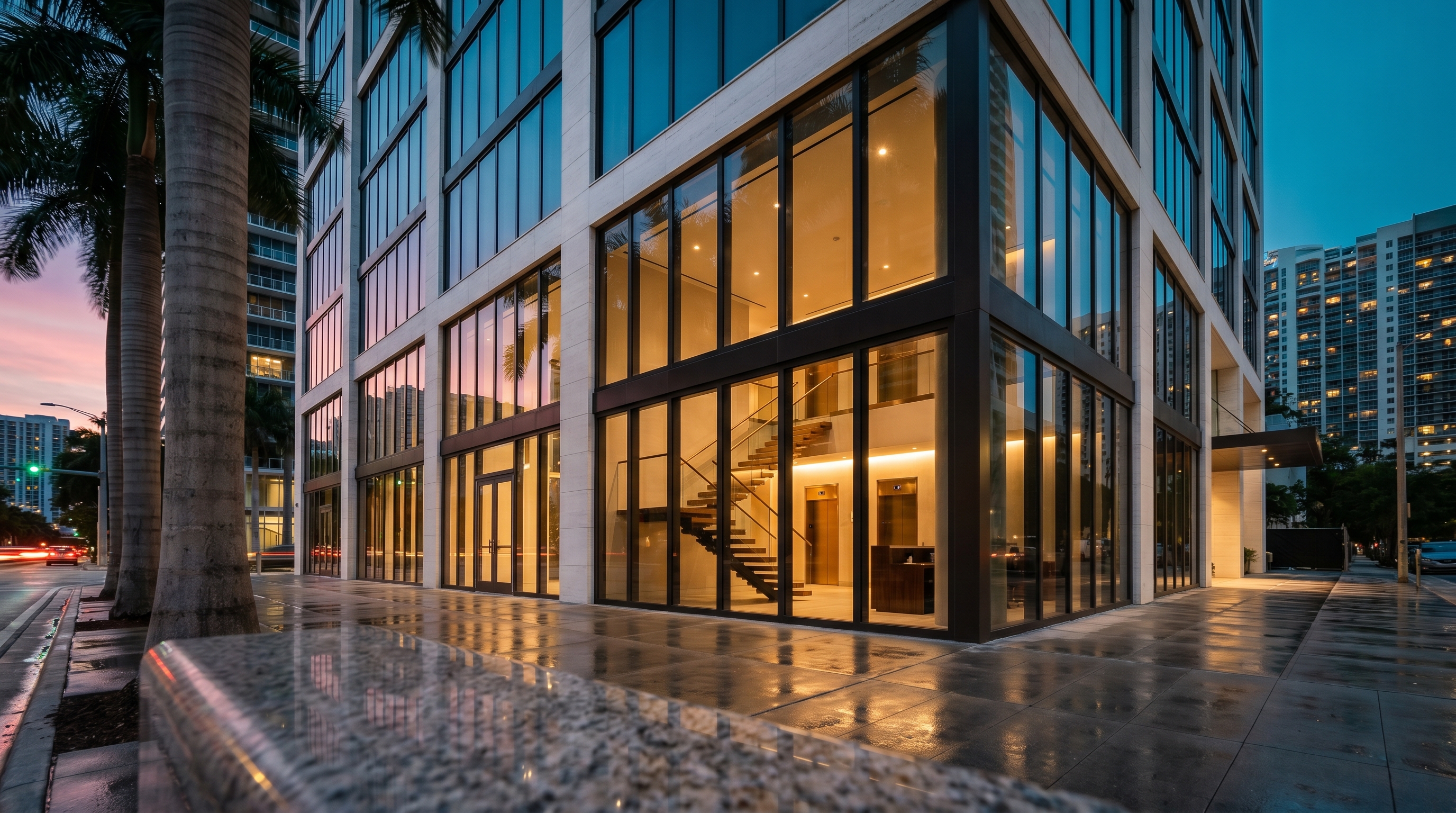

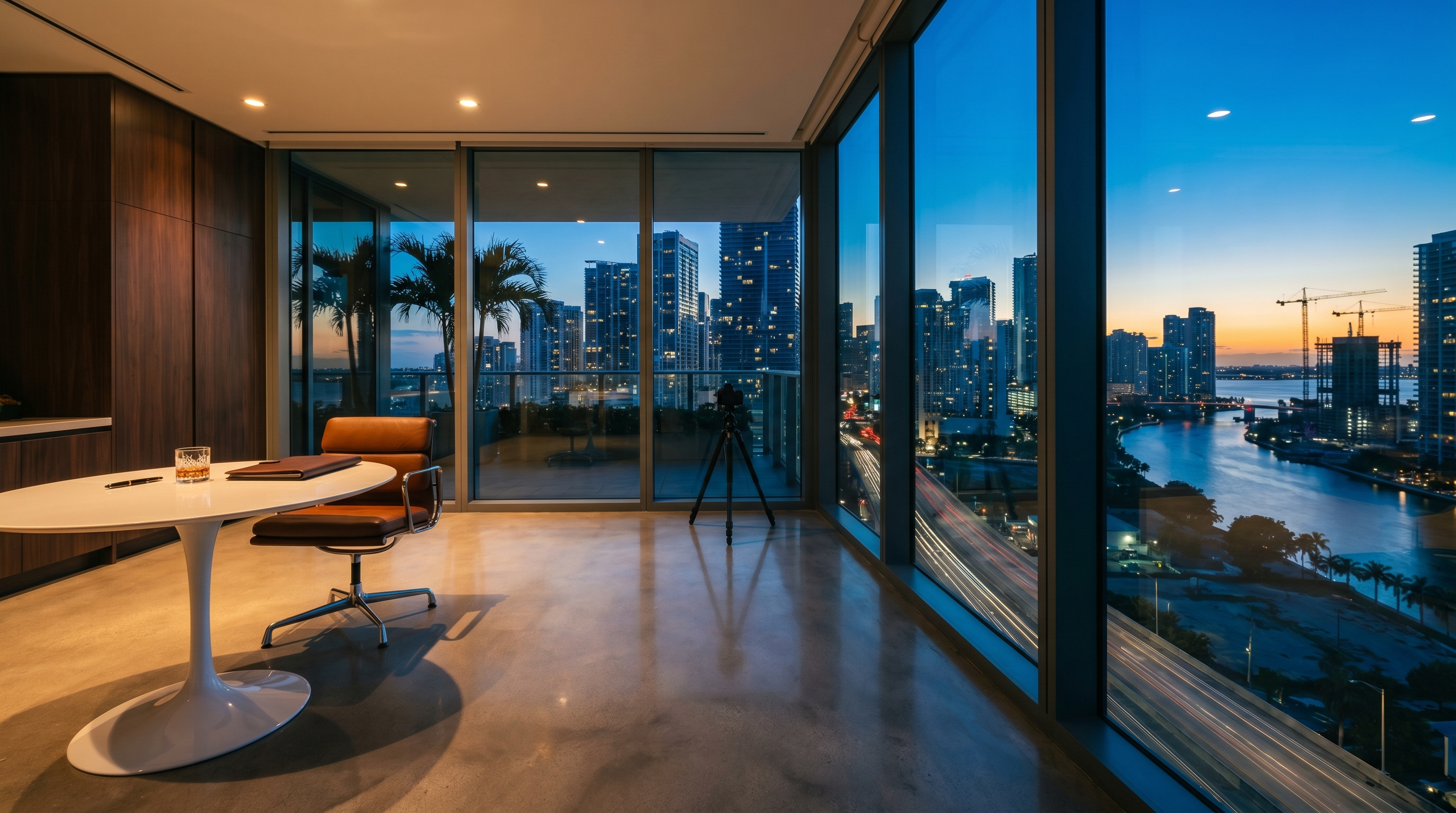
If you own a business in Miami and your office lease is up for renewal in the next twenty-four months, you need to read this before you sign anything.
This week brought a number that should change how every Miami entrepreneur thinks about real estate. Miami-Dade office asking rents officially crossed $200 per square foot in the city's premium submarkets, with letters of intent confirming the threshold across multiple Class A buildings. Signed deals are now "regularly exceeding $150 per square foot," according to industry reporting from May 18 and 19. That isn't just a record. That's a structural shift.
I work with Miami business owners every week — restaurants in Brickell, law firms in Coral Gables, dental practices in Doral, family offices in Coconut Grove. Until about eighteen months ago, the conversation about owning versus renting was a coin flip. Today, for any business writing a rent check north of $80,000 a year, the math has flipped. Hard.
Here's what I want every Miami business owner to understand about what just happened — and what to do about it.
What "$200 per SqFt" actually means for your business
Let's translate the headline into something tangible. A modest 3,000-square-foot office in a Class A Brickell or Coral Gables building, at $200 per square foot full-service gross, costs $600,000 a year in rent. Even at the more common signed-deal rate of $150 per square foot, you're looking at $450,000 a year. Over a typical ten-year lease with built-in escalations of 3% per year, you'll pay roughly $5.15 million to your landlord — and own nothing at the end of it.
Now run the same math on owning the building. A 6,000-square-foot commercial condo in the same area (you occupy half, lease the rest) at $700 per SqFt purchase price is $4.2 million. With an SBA 504 loan at 10% down, your equity check is $420,000. Your monthly debt service on the remaining $3.78 million sits in the range of $24,000 to $27,000 depending on rate structure. Add taxes, insurance, and maintenance — call it $40,000 monthly fully loaded. That's $480,000 a year.
Sound similar to renting? Look closer. You're paying principal down, depreciating the building against your business income, and capturing every dollar of appreciation. Your rental tenant in the other half of the unit covers a chunk of your carry. By year five, your effective cost of occupancy is often below zero.
This isn't theoretical. I've watched three different Miami business owners run this exact play in the last eighteen months, and every one of them is now paying themselves rent — through their property LLC — instead of paying a landlord.
The tax math is the real story
Office rent is a 100% deductible business expense. So is mortgage interest, property tax, insurance, and operating cost on a building you own. But owning unlocks two additional layers that renting can never touch.
The first is depreciation. The IRS lets you depreciate commercial real estate over 39 years on a straight-line basis. On a $4.2 million building (excluding land), that's roughly $86,000 a year in paper losses that reduce your taxable income without touching your cash flow. Run a cost segregation study and you can accelerate a meaningful portion of that into the first five to seven years — sometimes pulling $300,000 or more of deductions forward into year one. I covered this in detail in my article "Cost Segregation for Miami Real Estate Investors," and the strategy applies just as cleanly to your owner-occupied office.
The second is appreciation. Miami commercial property has compounded at roughly 5–7% annually over the past decade in the better submarkets. On a $4.2 million building, that's $210,000–$294,000 a year in equity growth you keep. Your landlord has been keeping it. Now it's yours.
The SBA 504 loan changes the equity equation entirely
The single biggest reason more business owners don't own their buildings is the down payment. Conventional commercial loans typically demand 25–35% down. On a $4.2 million purchase, that's $1.05–$1.47 million in cash out the door before you've signed a single check for your business operations.
The SBA 504 program collapses that to 10% down for owner-occupied commercial real estate. On the same $4.2 million building, you're putting up $420,000 — money that for most Miami business owners is well within reach, especially when you compare it to ten years of rent escalations you'll otherwise hand to a landlord. I wrote a full breakdown in "The SBA 504 Loan: How Miami Business Owners Buy Commercial Property With Just 10% Down," and the program remains the single most powerful tool for entrepreneurs who want to convert rent into equity.
Why the window is closing faster than you think
Three forces are squeezing this opportunity in 2026.
First, office rents are still climbing. The $200/SqFt number is a ceiling for today, not for next year. Every quarter you wait to lock in a purchase price, the cost of the alternative — renting — gets uglier.
Second, commercial inventory in Miami's prime submarkets is genuinely tight. Class A office buildings in Brickell, Coral Gables, and Coconut Grove rarely change hands, and when they do, sellers are negotiating from strength. I'm seeing multiple-offer situations on commercial condos under $5 million.
Third, the SBA 504 program isn't guaranteed forever. Federal program parameters get tweaked annually, and the current 10% down structure for owner-occupied property is one of the most generous it's been. Smart money is moving while the rules favor buyers.
Miami Market Snapshot — May 2026:
- Miami-Dade office asking rents: $200+/SqFt in premium submarkets (record high)
- Signed office deals regularly exceeding $150/SqFt full-service gross
- Active condo inventory: approximately 13 months of supply across Miami-Dade — a multi-year high
- Median Miami-Dade single-family home price: ~$650K (essentially flat year-over-year)
The deal-killers I see business owners make
Three mistakes show up over and over when entrepreneurs try to do this without help.
The first is shopping by price per square foot alone. A $500/SqFt commercial condo in a tired building with deferred maintenance, a fractured condo board, and rising assessments is worse than a $750/SqFt building in a professionally managed asset. I cover the same red-flag framework in "How to Read a Miami Condo Building's Financials Before You Buy" — the principles apply directly to commercial.
The second is underestimating the timeline. SBA 504 financing typically takes 60–90 days to close, and many sellers won't entertain offers without proof of qualification up front. Get pre-qualified before you start looking, not after you've fallen in love with a building.
The third is treating this like a real estate decision when it's really a corporate finance decision. Get your CPA, your business attorney, and your real estate agent in the same room — early. The structure (operating company leasing from a real estate LLC you own) is what unlocks the tax math.
Frequently Asked Questions
Q: Can a Miami business owner really buy commercial property with only 10% down?
A: Yes, through the SBA 504 loan program for owner-occupied commercial real estate. Your business must occupy at least 51% of the building, you need reasonable credit and business financials, and the property must qualify. On a $4 million building, that's a $400,000 equity check instead of $1+ million conventionally.
Q: Is the Miami commercial real estate market a good buy in 2026?
A: For owner-occupiers specifically — yes. Class A office rents are at record highs and still climbing, while commercial purchase prices haven't kept pace. That gap is what makes buying mathematically attractive right now. Pure investors face a different calculus.
Q: How do I get the best Miami realtor for commercial property?
A: Find an agent who actually closes commercial deals in your target submarket and understands SBA financing, depreciation, and the 1031 exchange — not just residential. The right realtor saves you six figures by structuring the deal correctly the first time.
Q: What's the difference between renting and owning for tax purposes in Miami?
A: Rent is fully deductible but builds no equity. Ownership lets you deduct interest, property tax, insurance, and operating costs while also capturing depreciation (a paper loss) and appreciation (a real gain). The combined tax shield typically adds 25–35% to the true return on ownership.
¿Listo para hacer tu movimiento? Llámame.
Carlos Cabale / Partnership Realty Inc / +1 (561) 629-0358 / carloscabalerealtor.com