
If you've been reading the headlines about the Miami condo market in 2026, you've probably seen two completely contradictory stories:
"Miami condo prices are slipping for the first time in years."
"Brickell branded residences hit a new record at $6,300 per square foot."
Both are true. And the only way they can both be true is if you understand what's actually happening underneath the headline numbers — because the Miami condo market in mid-May 2026 has split in two, and the old market reports that quote a single citywide average are useless to you as a buyer, seller, or investor.
Let me walk you through what I'm seeing on the ground right now, the data behind it, and what you should actually do depending on which side of the split your property — or your purchase target — sits on.
The Two-Tier Reality
Strip away all the noise and Miami's condo inventory in May 2026 looks like this:
Roughly 20% of the buildings — call this the "Strong" tier — are still gaining value. These are the branded residences, signature-architect towers, recently delivered luxury product, and the rare older buildings with bulletproof financials. Mandarin Oriental Brickell Key, St. Regis Brickell, Four Seasons Surfside, the Faena, Eighty Seven Park — these buildings are not just holding their record prices, they're trading higher in 2026 than they did in 2025. Days on market for resales here: often under 30. Bidding situations still happen.
Roughly 30% of the buildings — the "Stable" tier — are essentially flat. Established boutique buildings in Edgewater and Brickell that delivered 2018–2022, well-managed Coconut Grove and Coral Gables product, and Miami Beach mid-rise condos with healthy reserves and reasonable HOA dues. Prices here are within 2–3% of where they sat 12 months ago. Days on market: 60–90. Standard negotiations.
And then there's the "Weak" tier — the remaining 50%. Older buildings (most pre-2010), buildings hit with brutal special assessments after Surfside-driven inspections, towers with structural reserve shortfalls, and condos in oversupplied micro-markets like parts of Sunny Isles and downtown. Median per-square-foot prices in this segment have rolled back 6–11% over the past 18 months. Inventory is climbing. Days on market is stretching past 120 days for many listings.
When you mix all three tiers together, you get the headline number that everyone quotes: median per-square-foot price in Miami-Dade slipped about 1.2% year-over-year. That number is technically correct and practically meaningless. The market your specific property lives in is not the average. It's almost certainly trading dramatically better or dramatically worse.
The Surfside Hangover Is Still Driving Behavior
We are now nearly five years past the Champlain Towers South collapse. The state-mandated milestone inspection requirements, the new reserve funding rules under SB-4D, and tougher underwriting from condo insurance carriers have permanently reshaped the economics of older Miami condo buildings. Special assessments of $50,000 to $200,000+ per unit have hit buildings across the county. Monthly maintenance fees in many older towers have jumped 80–140% since 2021.
For unit owners in those buildings, the calculus has gotten brutal. Many are choosing to sell at any price to avoid the next assessment. That motivated-seller dynamic is the single biggest force pushing the bottom 50% of Miami's condo inventory lower. As I covered in 'Selling a Miami Property in 2026: The Pricing Strategy That Actually Closes Right Now,' the buildings carrying assessment risk now require pricing 10–18% below comps from 2022 to actually move.
Where the Buyers Are Going
The flip side is just as important. The buyers haven't disappeared — they've reallocated. In 2026, the buyers I'm working with are demanding three things before they'll write a real offer on a Miami condo:
1. Healthy reserves and a clean structural inspection report, with no pending special assessments.
2. Predictable HOA fees, ideally with a recent budget review.
3. A building with either branded operator backing, signature architecture, or bulletproof location (waterfront, on a bay, on the ocean).
When all three boxes get checked, those properties trade fast and at a premium. When even one is missing, buyers want a discount of 8–15% versus the comps. When two are missing, buyers walk.
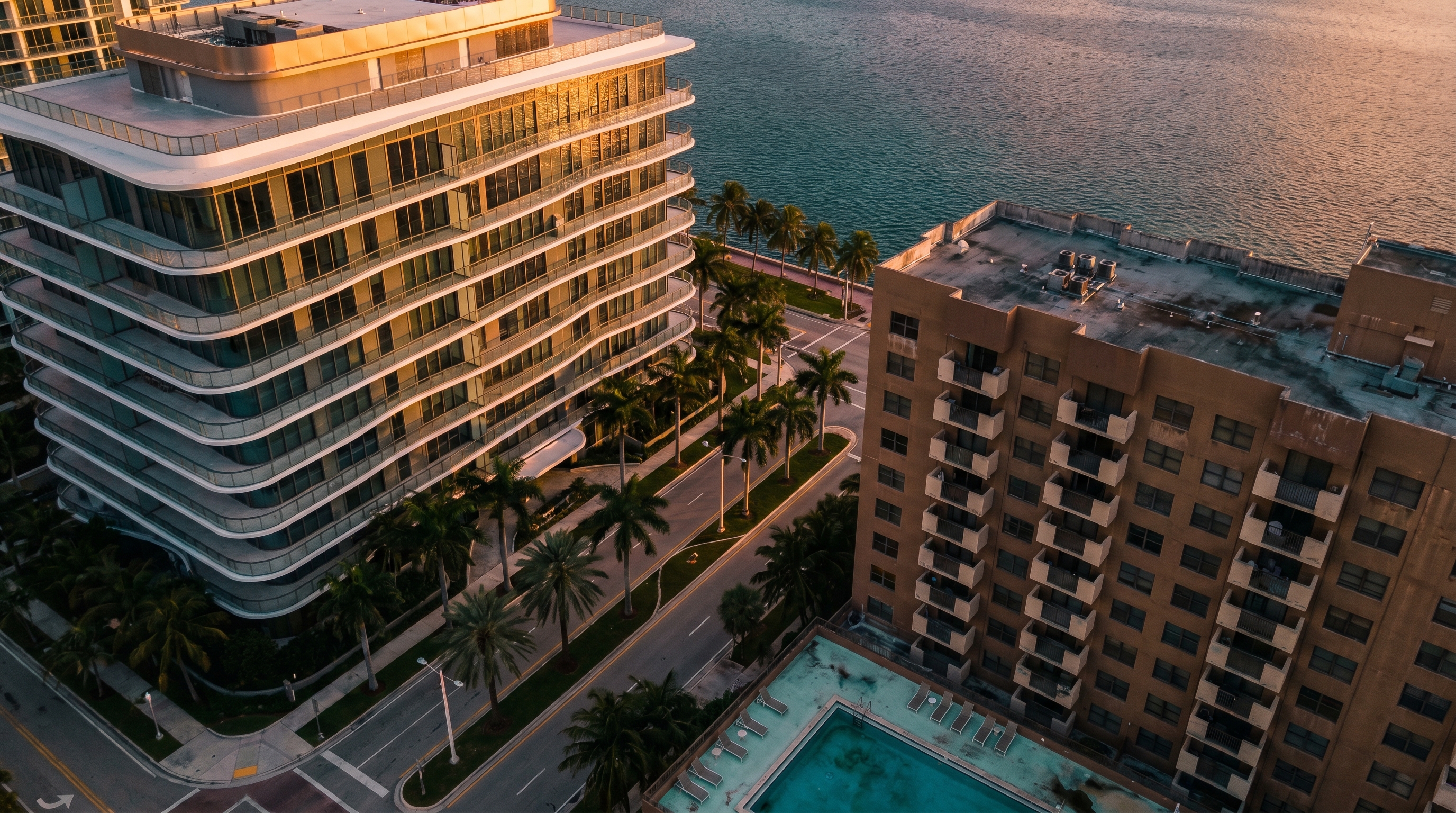
This is why the branded residences keep setting records while the building two blocks away from the same beach is selling for what it sold for in 2018. The product type isn't the same anymore — the buyer perceives them as completely different asset classes.
Neighborhood-Level Reality Check
A few specifics from what I'm seeing on the ground in May 2026:
Brickell: The split is the sharpest here. Buildings like Cipriani, Mercedes-Benz Places, 1428 Brickell, and the newer branded inventory are pulling pricing higher. Older Brickell condos — particularly those built 2005–2008 — are seeing the most price compression in the city. The two markets exist on the same block.
Edgewater: The "newer is winning" trend is even more pronounced. Villa Miami, The Cove, and Pagani-style branded product are absorbing buyer attention. Some older Edgewater buildings have seen days on market double over the past 12 months as buyers move toward the new product 1,000 feet away.
Coconut Grove and Coral Gables: These boutique markets have stayed remarkably stable. Limited new supply, high owner-occupant ratios, and lower assessment risk insulate Grove and Gables condo owners from the worst of the correction. As I mapped out in 'Living in Coconut Grove,' the supply-constrained nature of these neighborhoods is doing the heavy lifting.
Sunny Isles: Mixed bag. Bentley Residences, Estates at Acqualina, and other ultra-luxury product are still trading at premiums. The middle-tier Sunny Isles condo market (older, non-branded) is the softest segment in this neighborhood I've tracked in years.
Miami Beach: South of Fifth and Faena District remain strongholds. The rest of South Beach, particularly buildings without ocean views, has more flexibility for buyers right now than at any point since 2020.
Miami Market Snapshot — May 2026:
- Median per-square-foot price, Miami-Dade overall condos: ~$590/sqft (down 1.2% YoY)
- Branded residence index (top 20% of buildings): up 3.4% YoY
- "Weak tier" buildings (pre-2010, with assessment risk): down 6–11% over 18 months
- Active condo inventory, Miami-Dade: roughly 17,400 units (up ~9% from May 2025)
What to Do Right Now
If you're a buyer: This is the best buyer's market in Miami's mid-tier condo inventory in years. If you're patient, willing to do reserve studies, and willing to look at buildings with assessment uncertainty already known and priced in, there are 15–25% discount opportunities versus 2022 comps. Don't try to bottom-fish the trophy buildings — those are still moving.
If you're a seller in a Strong-tier building: Sit tight, list confidently, and don't accept the first lowball. Your buyers are still bidding.
If you're a seller in a Weak-tier building: Price aggressively and move now. The summer buying season historically brings out the most negotiating leverage for buyers, and waiting another 6 months will likely cost you more than pricing 5–8% under your current comp dream.
If you're an investor: Look at distressed older buildings with clean inspections coming and good bones — these are buy opportunities for patient capital. Avoid older buildings with pending assessments unless the seller is pricing the assessment fully into the discount.
Frequently Asked Questions
Q: Are Miami condo prices going down in 2026?
A: It depends entirely on the building. Citywide median prices slipped about 1.2% year-over-year through April 2026, but that average masks a sharp split — branded and luxury new towers are up 3–8%, while older buildings facing assessment pressure are down 6–11%. The "average" doesn't apply to any single property.
Q: Why are some Miami condos still selling for record prices in 2026?
A: Buyers are concentrating capital in branded residences, signature-architect towers, and waterfront product where reserves are healthy and special assessments are unlikely. Buildings like Mandarin Oriental, St. Regis, and Four Seasons trade at record prices because they offer predictability — something buyers value enormously after Surfside.
Q: Is now a good time to buy a Miami condo?
A: It's the best buyer's market in Miami's mid-tier condo inventory since 2020 — if you choose carefully. Buyers willing to vet building reserves, inspections, and HOA financials can find 15–25% discounts versus 2022 comps in the weaker segment. Trophy buildings remain competitive.
Q: What is making Miami condo HOA fees so high right now?
A: Three forces: state-mandated structural inspection requirements after Surfside (SB-4D), tougher reserve funding rules, and steep increases in condo insurance premiums. Older buildings with deferred maintenance have absorbed the largest hits, with some seeing maintenance fees climb 80–140% since 2021.
¿Listo para hacer tu movimiento? Llámame.